Strategic Separation: Netanyahu Is Distancing From Haredim, But Not Divorcing Them
Kol B'Rama journalist Avi Moskoff explains why Netanyahu and Haredi coalition partners are strategically attacking each other on values and conscription while careful to avoid breaking the government—a calculation borrowed from US-Iran playbook.
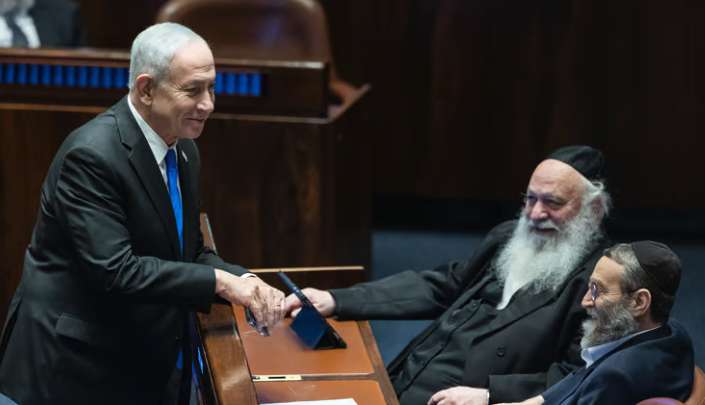
Israel's coalition government is executing a carefully calibrated strategy of controlled conflict with its Haredi partners, maintaining ideological distance on conscription and values while explicitly avoiding the kind of mutual attacks that could fracture the right-wing bloc entirely, according to analysis from a journalist who works for Kol B'Rama, Avi Moskoff.
The strategy, which Moskoff compares to international conflict management between Iran and the U.S., allows Netanyahu to distance himself from Haredi political interests on conscription and Torah study subsidies, damage control after electoral losses tied to controversial conscription legislation, while preserving the coalition's slim parliamentary majority.
Speaking to Yanir Kozin on Knesset channel 99, Moskoff outlined the mechanics: both sides are benefiting from the current dynamic. Netanyahu is distancing himself ideologically from Haredi positions on military service and religious study, a necessary political move after the Likud suffered electoral damage from conscription-related laws including the detention law. The Haredi parties, meanwhile, are largely staying silent rather than escalating, allowing the government to appear distanced from Haredi interests without triggering a coalition crisis.
"Both sides want to keep the fire low," Moskoff stated, describing the situation as deliberately contained. "Nobody wants this to spiral into mutual attacks, because the moment it does, the event goes out of control."
Moskoff drew a direct parallel to US-Iran military friction. Both powers have engaged in strikes and confrontations in the Strait of Hormuz and surrounding waters, but neither has opted for full-scale warfare. The conflict remains compartmentalized precisely because both sides understand that escalation would carry costs neither can afford.
The Israeli coalition dynamic mirrors this calculation: Netanyahu and the Haredi parties can afford measured distance on conscription and ideology. What they cannot afford is open warfare over the coalition itself.
The Haredi press has notably declined to amplify anti-Netanyahu rhetoric or call for electoral mobilization against the government. Major publications including Arutz Neeman, Hamevaser, and Hamodiah have covered the Netanyahu-Haredi friction with minimal emphasis, according to Moskoff's review of morning coverage. This silence, he suggested, is strategic: the Haredi parties are choosing not to fuel a political escalation campaign that would force Netanyahu to respond with harder-edged attacks.
"If the Haredi press had responded aggressively to Netanyahu, it would have created pressure for mutual escalation," Moskoff explained. "The fact that they've stayed relatively quiet tells you both sides understand the stakes."
The underlying dynamic reflects electoral and ideological calculations. Netanyahu has been trying to reposition himself away from Haredi policy preferences—particularly on conscription and subsidies for religious study—to appeal to secular voters. Recent controversial legislation pushed through with Haredi support damaged Netanyahu's standing among Israel's secular center, and he is attempting to recover by creating political distance.
But severing the coalition entirely would cost Netanyahu his parliamentary majority and likely trigger elections neither he nor the Haredim can afford. The Haredi parties, while frustrated with some government policies, also face electoral uncertainty. Maintaining the status quo of "controlled conflict" allows both sides to manage political losses while preserving the coalition framework.
Moskoff warned that this equilibrium is fragile. If the conflict transitions from ideological distance-keeping to mutual political attacks, the dynamic could spiral. "Once you enter into repeated attacks, the event can go out of control, and then you enter into the political dynamics of the right-wing bloc more broadly," he said, noting that the right-wing coalition is already "in danger" despite recent legislative successes on military and legal issues.
The right-wing bloc has managed significant legislative accomplishments in recent weeks, passing controversial laws with unusual unity among coalition partners. But the underlying political strain remains. The conscription question, tied to fundamental religious and ideological differences, remains unresolved. The government is managing it through strategic separation rather than resolution.
For diaspora observers tracking Israeli politics, the arrangement illustrates the fragility of Netanyahu's coalition: it survives not through policy consensus but through mutual interest in avoiding breakdown. The precedent, whether from Iran strategy or domestic coalition math, is that controlled low-level conflict can persist indefinitely so long as both parties have stronger incentives to maintain the arrangement than to escalate it.
The question facing Netanyahu's government is whether those incentives will hold through the election cycle, or whether electoral pressures will eventually force one side or the other to abandon the strategy of managed distance.